以市面上備受矚目的 Panasonic A La Uno 全自動洗淨馬桶為例,就是將材料科學、結構工程與流體力學發揮到極致的典型代表:
1. 材料層:有機玻璃系新素材
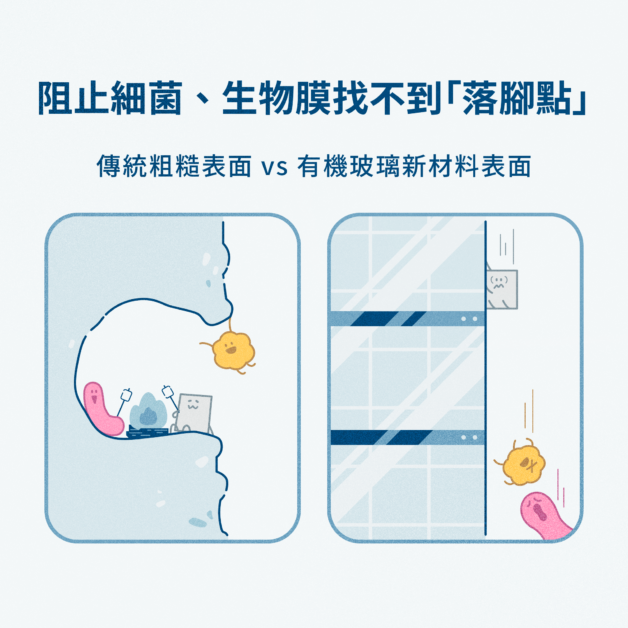
A La Uno 全自動洗淨馬桶採新開發的「有機玻璃系新素材」(以壓克力高分子為基礎研發的衛浴專用材料,這類高分子成形技術亦被廣泛運用於大型水族館高壓觀景窗與飛機機艙罩)。這種材料表面具備極佳的疏水性與耐水垢特性,水滴不易長時間攤平停留;材質堅固、不易破裂,耐刮、不易造成細小傷痕。通過實驗測試,這種素材配合泡沫洗淨,在沖洗後能有效沖刷掉高達 99.99% 的大腸桿菌,從源頭阻斷細菌定殖。
-----廣告,請繼續往下閱讀-----
2. 結構層:無接縫工藝與三重防濺防護
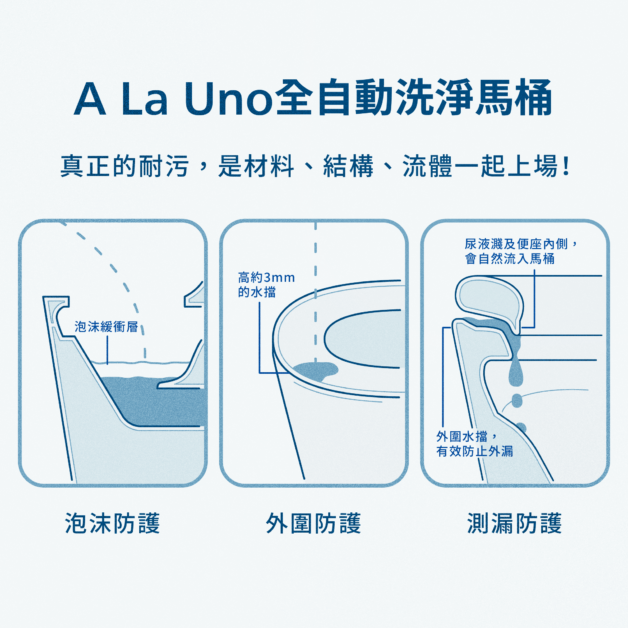
在宏觀結構上,A La Uno 全自動洗淨馬桶採用無水箱沖水與便器、溫水洗淨便座一體成型設計,減少傳統水箱與座體之間的結構層次及接縫,並搭配可動迴轉式排水系統完成沖洗。更貼心的是其「三重防護」設計:
泡沫防護:在水面上製造一層充沛的泡沫緩衝層,有效抑制男性站立小便時的尿液與污水飛濺;
外圍防護:馬桶邊界特別設計了高約 3mm 的水檔,防止液體延著外壁滴落至地板;
測漏防護:便座與馬桶本體採用不外露的防護設計,避免液體從縫隙飛濺滲漏。
Panasonic A La Uno 全自動洗淨馬桶
3. 動態流體層:雙效泡沫洗淨、漩渦水流與 nanoe™ X
當污垢降落在馬桶內壁時,A La Uno全自動洗淨馬桶 的動態流體科技便接手進行徹底打掃。其「雙效泡沫洗淨」會先釋放直徑約 5mm 的「毫米泡沫」包裹並帶走大塊髒污,再透過直徑約 60微米的「微米泡沫」深入微觀縫隙,徹底溶解殘餘的油脂與細微污垢。接著,配合高度清潔力的「漩渦型強力水流」,利用旋轉產生的流體剪切力,一口氣將附著力已被削弱的污垢剝離並沖走。此外,Panasonic A La Uno 全自動洗淨馬桶還搭襯了 nanoe™ X 健康科技,釋放氫氧離子有效抑制異味與髒污,維持空氣與內壁的良好衛生狀態。
原文研究: “The The The The Induction of Jamais Vu in the Laboratory: Word Alienation and Semantic Satiation,” Chris J. A. Moulin, Nicole Bell, Merita Turunen, Arina Baharin, and Akira R. O’Connor, Memory, vol. 29, no. 7, 2021, pp. 933-942. doi.org/10.1080/09658211.2020.1727519
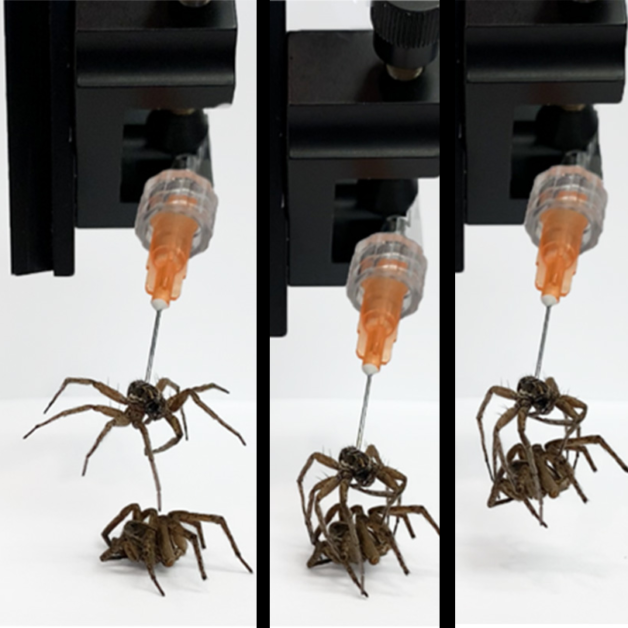
原文研究:“Necrobotics: Biotic Materials as Ready-to-Use Actuators,” Te Faye Yap, Zhen Liu, Anoop Rajappan, Trevor J. Shimokusu, and Daniel J. Preston, Advanced Science, vol. 9, no. 29, 2022, article 2201174. doi.org/10.1002/advs.202201174
“A Mountable Toilet System for Personalized Health Monitoring via the Analysis of Excreta,” Seung-min Park, Daeyoun D. Won, Brian J. Lee, Diego Escobedo, Andre Esteva, Amin Aalipour, T. Jessie Ge, et al., Nature Biomedical Engineering, vol. 4, no. 6, 2020, pp. 624-635. doi.org/10.1038/s41551-020-0534-9
“Digital Biomarkers in Human Excreta,” Seung-min Park, T. Jessie Ge, Daeyoun D. Won, Jong Kyun Lee, and Joseph C. Liao, Nature Reviews Gastroenterology and Hepatology, vol. 18, no. 8, 2021, pp. 521-522. doi.org/10.1038/s41575-021-00462-0
“Smart Toilets for Monitoring COVID-19 Surges: Passive Diagnostics and Public Health,” T. Jessie Ge, Carmel T. Chan, Brian J. Lee, Joseph C. Liao, and Seung-min Park, NPJ Digital Medicine, vol. 5, no. 1, 2022, article 39. doi.org/10.1038/s41746-022-00582-0
“Passive Monitoring by Smart Toilets for Precision Health,” T. Jessie Ge, Vasiliki Nataly Rahimzadeh, Kevin Mintz, Walter G. Park, Nicole Martinez-Martin, Joseph C. Liao, and Seung-min Park, Science Translational Medicine, vol. 15, no. 681, 2023, article eabk3489. doi.org/10.1126/scitranslmed.abk3489
研究對象以西班牙語為母語,他們能在對話中輕鬆地將 banana 念成 ananab,或是將「 basket is fun」念成「nuf si teksab」。研究著重在這兩位有著特殊能力的人,推理、記憶能力是否優於常人,以及大腦灰質、白質比例與一般人(對照組)是否有差別。
大腦如何組織語言一直都是個有趣的研究題目,像是為什麼中文的序順不會響影到閱讀,這也是 A 編跟大家都一樣好奇的。而了解大腦語言是如何形成的,也能推進對於失語症、癡呆症的症狀研究。
-----廣告,請繼續往下閱讀-----
原文研究:“Neurocognitive Signatures of Phonemic Sequencing in Expert Backward Speakers,” María José Torres-Prioris, Diana López-Barroso, Estela Càmara, Sol Fittipaldi, Lucas Sedeño, Agustín Ibáñez, Marcelo L. Berthier, and Adolfo M. García, Scientific Reports, vol. 10, no. 10621, 2020. doi.org/10.1038/s41598-020-67551-z
原文研究:“The Quantification and Measurement of Nasal Hairs in a Cadaveric Population,” Christine Pham, Bobak Hedayati, Kiana Hashemi, Ella Csuka, Margit Juhasz, and Natasha Atanaskova Mesinkovska, Journal of The American Academy of Dermatology, vol. 83, no. 6, 2020, pp. AB202-AB202. doi.org/10.1016/j.jaad.2020.06.902
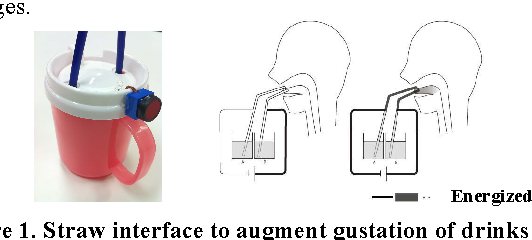
原文研究:“Augmented Gustation Using Electricity,” Hiromi Nakamura and Homei Miyashita, Proceedings of the 2nd Augmented Human International Conference, March 2011, article 34. doi.org/10.1145/1959826.1959860
“Boredom Begets Boredom: An Experience Sampling Study on the Impact of Teacher Boredom on Student Boredom and Motivation,” Katy Y.Y. Tam, Cyanea Y. S. Poon, Victoria K.Y. Hui, Christy Y. F. Wong, Vivian W.Y. Kwong, Gigi W.C. Yuen, Christian S. Chan, British Journal of Educational Psychology, vol. 90, no. S1, June 2020, pp. 124-137. https://pubmed.ncbi.nlm.nih.gov/31342514/
“Whatever Will Bore, Will Bore: The Mere Anticipation of Boredom Exacerbates its Occurrence in Lectures,” Katy Y.Y. Tam, Wijnand A.P. Van Tilburg, Christian S. Chan, British Journal of Educational Psychology, epub 2022. doi.org/10.1111/bjep.12549
原文研究:“Note on the Drawing Power of Crowds of Different Size,” Stanley Milgram, Leonard Bickman, and Lawrence Berkowitz, Journal of Personality and Social Psychology, vol. 13, no. 2, 1969, pp. 79-82. psycnet.apa.org/doi/10.1037/h0028070
原文研究: “Intense Upper Ocean Mixing Due to Large Aggregations of Spawning Fish,” Bieito Fernández Castro, Marian Peña, Enrique Nogueira, Miguel Gilcoto, Esperanza Broullón, Antonio Comesaña, Damien Bouffard, Alberto C. Naveira Garabato, and Beatriz Mouriño-Carballido, Nature Geoscience, vol. 15, 2022, pp. 287–292. doi.org/10.1038/s41561-022-00916-3
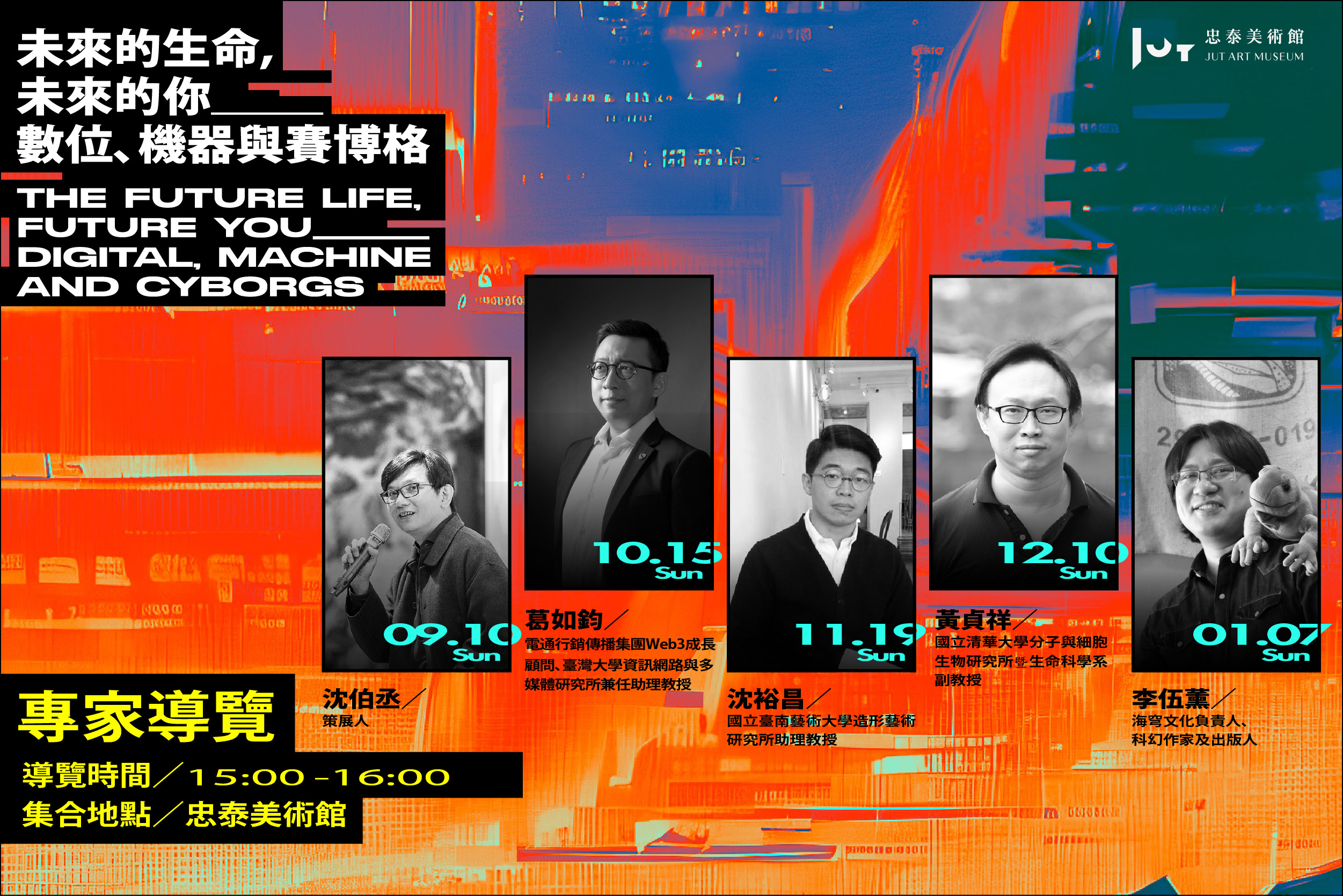
忠泰美術館即將於 9 月 9 日至 2024 年 1 月 28 日推出全新當代藝術展《未來的生命,未來的你─數位、機器與賽博格》(The Future Life, Future You – Digital, Machine and Cyborgs)。延續上檔展覽中以建構城市與文明的基礎「人」出發,由反思擁有肉身的「人類」存在與本質,進一步探問「生命何為」,思考人與科技共構的未來生命情境與議題。本展邀請沈伯丞擔任策展人,匯集來自英、美、法、日、德國與埃及、西班牙、墨西哥、臺灣共 15 組國外內藝術家與團體,帶來 6 組全球首展與 4 組全臺首度亮相的新作,透過 AI 演算、大數據、深偽技術、穿戴裝置、賽博格等科技與藝術的結合創作,映射出藝術家們對未來生命形貌的多元想像。
生命何為:生命是什麼?能做什麼?為了什麼?
當 AI 人工智慧、機械穿戴手臂從科幻電影橋段躍入我們的日常生活中,科技改變生活,也逐漸影響了生命的樣貌與演化,生命開始超越人類肉身的物理型態時,我們又該如何去思考未來的生命與生活?忠泰美術館本次邀請沈伯丞擔任策展人,以其長期的藝術計畫「再・創世:智慧生命的衍生型態」研究為基礎,從生命是一個持續發展中、創造中的概念出發,策劃當代藝術展《未來的生命,未來的你─數位、機器與賽博格》,從藝術視角思辨,當科技介入了生活與生命,生物六大分類之外是否還將多出「科技界」?物競天擇「演化論」與科技始終來自於人性的「控制論」交會之下,未來的生命與生活情境又會有怎樣的想像。
英國藝術家傑克.艾維斯(Jake Elwes)首度在臺展出的〈Zizi 動起來:深偽變裝烏托邦〉,將深偽技術(deepfake)與酷兒群體結合,從 AI 演算中誕生的變裝皇后們,在如同櫥窗的螢幕中不斷流轉變換軀體與角色,企圖反思人工智慧的族群概念,打破固化的性別與身體定義。臺灣藝術家蘇匯宇的〈The White Waters〉三頻道錄像作品,以「後人類」敘事補述經典傳說《白蛇傳》,從文本中人、蛇異種的身體流動,解構生物界的邊界。埃及建築師哈桑.拉賈(Hassan Ragab)的系列影像,提取人與建築的影像,透過 AI 圖像生成系統 Midjourney、Stable Diffusion 等,將建築從「生活機器」,幻化為能走秀、跳舞的人形「生物活體」。
關於人類於數位環境中對「自我」的認定,甫獲得林茲電子藝術獎的臺灣藝術團隊陽春麵研究舍─陳姿尹、莊向峰,於本展中將得獎作品《Inter net》系列延伸出兩組全新現地創作,接續探討 AI 演算中「我」的形象。空間互動裝置〈Inter net – Labeling me〉中,可見 AI 判讀標記、搜尋引擎記錄,以及機器人與觀者「眾包標註」下的「我」的形象。單頻道演算影像裝置〈The Portrait – The Crowd’s Portrait of Me〉與〈The Portrait – My Self-Portrait〉將描述藝術家的文本轉換成特徵向量,以看似雜訊的影像,勾勒出數位足跡中的認知肖像。
-----廣告,請繼續往下閱讀-----
陳萬仁作品〈歪腰一下〉,位於美術館天井中,讓觀者以仰望的視角,觀看由藝術家 3D 繪製的人形,將現實去背進行數位縫合,行走於數位時空裡無止盡的空循環與延伸。墨西哥藝術家馬爾.布埃諾(Mal Bueno)全球首次展出的作品〈終曲〉,將與作品互動的觀者形象上傳到數位維度中,直覺呈現數位演算法中的「你」。
2、「它」:演算誕生的新生命型態
當現實生活中的元素與概念轉化成編碼再重新生成,人的意識與選擇,又會如何影響新生命情境?臺灣藝術家黃新的全新創作〈生成速寫:多肉植物園〉即時演算影像裝置,便是將多肉植物由演算法生成速寫畫,以程式的幾何造型來解構日常的場景。陳乂的人造風動模擬裝置〈風場〉,以風量、風向與風的聲音資訊作為採集與實驗項目,將 AI 演算法生成的數據模型匯入機械裝置結合,由蘆葦般的發光體演繹一段模仿自然風吹的搖曳姿態。
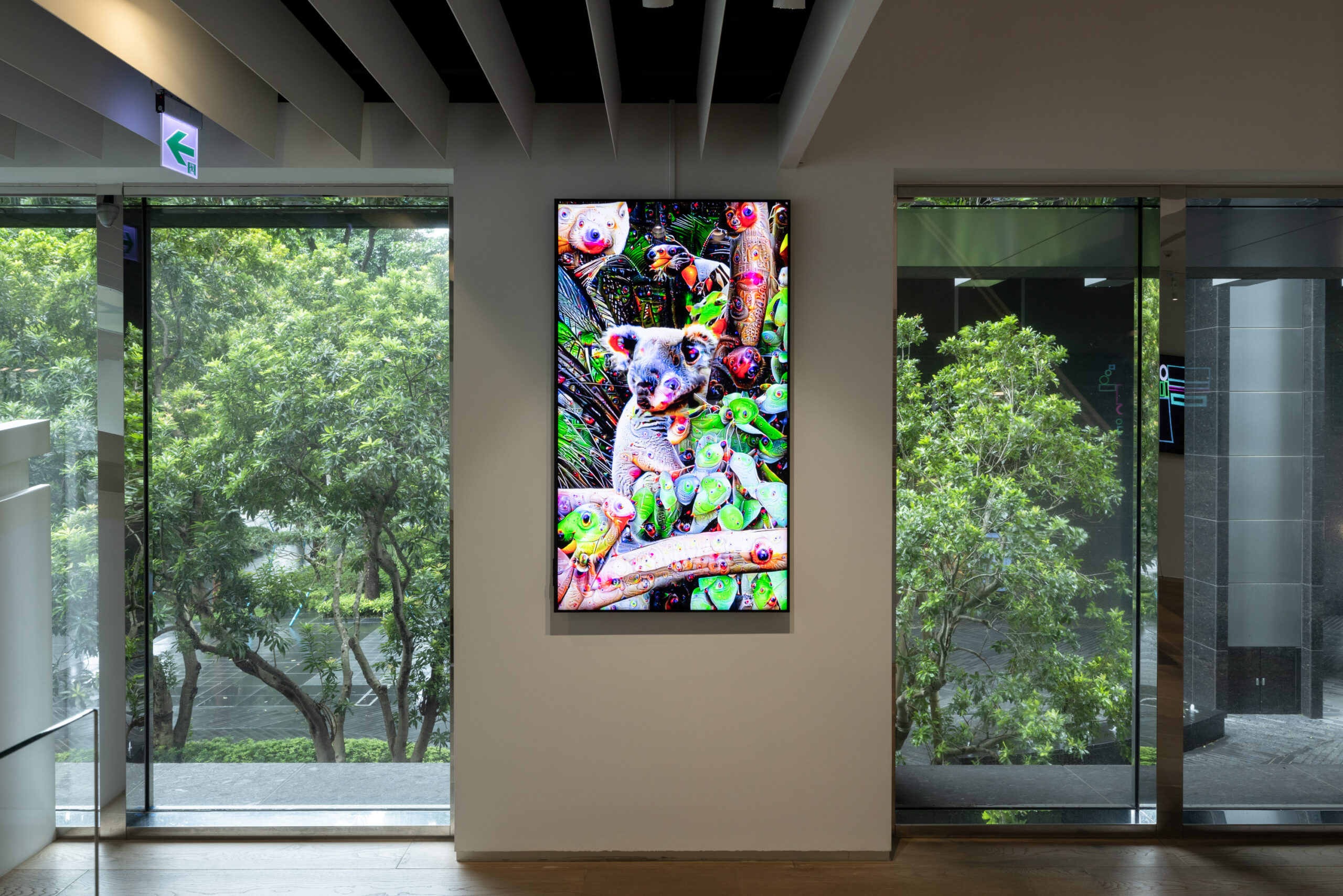
以數位人造生命為題,英國藝術家馬科斯.凱(Markos Kay)的〈非生物起源〉,直接在數位環境中生成擁有鮮豔色彩,如同細胞般的新物種,藝術家試圖透過創作生命探詢生命起源。在 TikTok 抖音擁有超過 50 萬粉絲的「Coolacloy」,創作者是來自美國的藝術家艾登.費海提(Aiden Faherty),本次展出的影像作品〈穿越超驗森林之旅〉為藝術家首次於國際間展出的作品,透過 AI 深層學習模型捕捉自然界資訊生成的生態系,讓觀者進入現實與想像無縫融合的《愛麗絲夢遊仙境》。
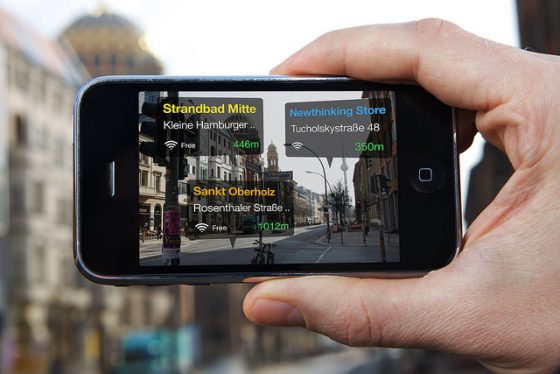
德國藝術家馬丁.貝克斯(Martin Backes)的擴增實境創作〈我知道什麼?我只是個機器?!〉,讓觀眾透過行動裝置與懸浮在美術館空間內的正圓球形機器人相遇、對話,藝術家試圖透過 AR 擴增實境昭示數位維度裡的新生命型態。
館方也嘗試於展覽周邊事務中導入 AI 技術應用,包括結合 Bing Image Creator AI 繪圖工具製作的展覽主視覺,以及 AI 聲音生成技術製作的語音導覽等。本展中多件影像創作,忠泰美術館與連續 17 年全球電視銷售第一的三星電子攜手合作,使用擁有 AI 影像升頻技術的 Neo QLED 8K,結合量子 Mini LED 背光與金屬量子點顯色技術,呈現藝術家於數位維度的創作中,新物種、新生命情境的絢麗幻想。《未來的生命,未來的你》從 9 月 9 日展至明年 1 月 28 日,期間將陸續推出展覽系列專題講座、電影與漫畫共享沙龍、專家導覽等多元活動,邀請觀眾一同想像「未來的生命,未來的你」。更多展覽活動與看展優惠資訊,詳見美術館官方網站。





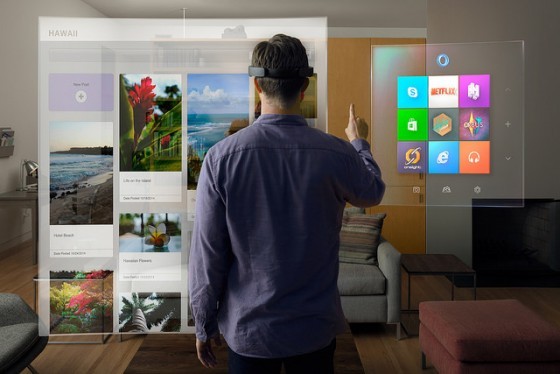 Microsoft HoloLens。圖/flickr @Microsoft Sweden











©忠泰美術館-scaled.jpg)