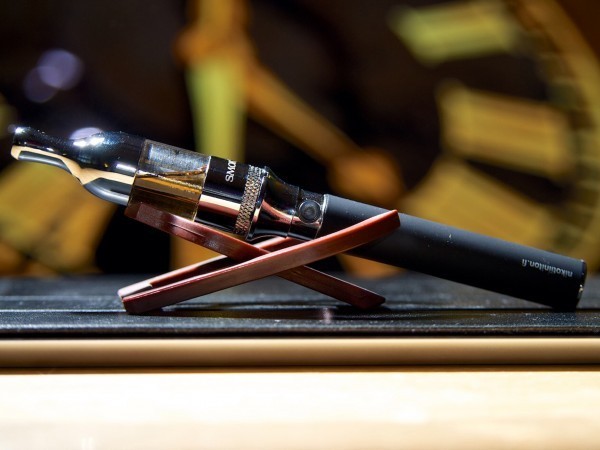
英國Cochrane中心,研究中隨機挑選出2組對照試驗,並參考11項先前的觀測研究,將已經試圖戒菸與未用電子菸戒菸的人相比較。主要作者倫敦歐勝預防醫學研究所(Wolfson Institute of Preventive Medicine)的行為專家海登.麥克羅比(Hayden McRobbie)表示:「總而言之,結果顯示電子菸對於阻止抽菸和減少香菸使用量是有幫助的。」
Cochrane中心試圖收集所有有關電子菸療法的嚴重不良反應,但並無所獲。麥克羅比表示:「不能說電子菸完全無害,因為我們還無法確定長期使用的結果。」而就先前的分析顯示,電子菸的蒸氣含有許多的有毒化學物質和重金屬,而這些化合物的劑量是否足以造成長期的健康疑慮尚待觀察,但和尼古丁所造成的傷害相比,舊金山加州大學菸草控制研究與教育中心(Center for Tobacco Control Research and Education at the University of California)的生物學家蘇珊.希克(Suzaynn Schick)表示:「電子菸的急性健康影響相較於尼古丁較小,因為它含有較少的毒素。」
當然,最安全且健康的做法就是不要抽任何形式的菸。但對於那些已經對尼古丁上癮的人來說,電子菸或許是其中較好的選擇。倫敦國王學院國家成癮中心(National Addiction Centre at King’s College London)的教授安.麥克尼爾(Ann McNeill)表示:「我們目前的主要討論為,可以如何提供最好的建議和幫助給使用產品的戒菸者,使他們越快達到成效越好。」Cochrane中心目前將進一步比較電子菸與其他療法如戒菸貼片,了解這些不同療法之間的安全性與成效。麥克羅比表示:「我們需要更多的數據去強化電子菸能夠戒除菸癮的論證。」
[2]Tefferi A. (2023). Primary myelofibrosis: 2023 update on diagnosis, risk-stratification and management. American Journal of Hematology.
[3]Naymagon, L., & Mascarenhas, J. (2017). Myelofibrosis-Related Anemia: Current and Emerging Therapeutic Strategies. HemaSphere, 1(1), e1. https://doi.org/10.1097/HS9.0000000000000001
[4]Fearon, K., Strasser, F., Anker, S. D., Bosaeus, I., Bruera, E., Fainsinger, R. L., Jatoi, A., Loprinzi, C., MacDonald, N., Mantovani, G., Davis, M., Muscaritoli, M., Ottery, F., Radbruch, L., Ravasco, P., Walsh, D., Wilcock, A., Kaasa, S., & Baracos, V. E. (2011). Definition and classification of cancer cachexia: an international consensus. The Lancet. Oncology, 12(5), 489–495. https://doi.org/10.1016/S1470-2045(10)70218-7
[5]Tremblay, D., Baine, I., & Mascarenhas, J. (2022). Thrombocytopenia in Patients With Myelofibrosis: A Practical Management Guide. Clinical lymphoma, myeloma & leukemia, 22(12), e1067–e1074. https://doi.org/10.1016/j.clml.2022.08.011
[6]Leiva, O., Liu, O., Kanelidis, A., Swat, S., Gozdecki, L., Belkin, M., Grinstein, J., Kalantari, S., Kim, G., DeCara, J., Chung, B., Patel, A., Odenike, O., Yang, E. H., Bloom, M., Alvarez-Cardona, J., How, J., & Hobbs, G. (2025). Beyond Thrombosis: Pulmonary Hypertension and Heart Failure in Patients With Myeloproliferative Neoplasms: JACC: CardioOncology State-of-the-Art Review. JACC. CardioOncology, 7(5), 538–553. https://doi.org/10.1016/j.jaccao.2025.05.010
[7]Harrison, C., Mesa, R., Ross, D., Mead, A., Keohane, C., Gotlib, J., & Verstovsek, S. (2013). Practical management of patients with myelofibrosis receiving ruxolitinib. Expert review of hematology, 6(5), 511–523. https://doi.org/10.1586/17474086.2013.827413
[8]Mughal, T. I., Vaddi, K., Sarlis, N. J., & Verstovsek, S. (2014). Myelofibrosis-associated complications: pathogenesis, clinical manifestations, and effects on outcomes. International journal of general medicine, 7, 89–101. https://doi.org/10.2147/IJGM.S51800
[9]Coates T. D. (2019). Iron overload in transfusion-dependent patients. Hematology. American Society of Hematology. Education Program, 2019(1), 337–344. https://doi.org/10.1182/hematology.2019000036
[10]Thaw, K., Harrison, C. N., & Sriskandarajah, P. (2024). JAK Inhibitors for Myelofibrosis: Strengths and Limitations. Current hematologic malignancy reports, 19(6), 264–275. https://doi.org/10.1007/s11899-024-00744-9
[11]Mora, B., Bucelli, C., Cattaneo, D., Bellani, V., Versino, F., Barbullushi, K., Fracchiolla, N., Iurlo, A., & Passamonti, F. (2024). Prognostic and Predictive Models in Myelofibrosis. Current hematologic malignancy reports, 19(5), 223–235. https://doi.org/10.1007/s11899-024-00739-6
[12]Kirito, K., Choi, C. W., Hein, T., Hou, H. A., Jung, C. W., Kwong, Y. L., Leung, G. M. K., Ooi, M. G. M., Rojnuckarin, P., Ross, D. M., Shih, L. Y., Takenaka, K., Teo, W. Z. Y., & Gill, H. (2025). Clinical Practice Recommendations for Myelofibrosis Management in the Asia-Pacific Region: The APAC-MF Alliance. JCO oncology practice, OP2400916. Advance online publication. https://doi.org/10.1200/OP-24-00916
[13]Ali, H., & Bacigalupo, A. (2024). 2024 update on allogeneic hematopoietic stem cell transplant for myelofibrosis: A review of current data and applications on risk stratification and management. American journal of hematology, 99(5), 938–945. https://doi.org/10.1002/ajh.27274