一則令人不安的環境新聞,卻只在極小眾的「人間福報」及「新紀元」看到,主流媒體理都不理,只會報導藍綠鬥爭、影劇八卦。
2011年9月7日「人間福報」報導路透社消息:北極海冰量 去夏創新低(新聞原文請點閱:Total Arctic Sea Ice At Record Low In 2010: Study)
【本報綜合外電報導】研究人員在即將刊登的報告指出,北極夏季最低海冰量去年創下新低,顯示夏季冰層變薄面積,超過冬季恢復面積。
根據海冰面積和厚度綜合統計,研究估計,去年海冰量最低點突破二○○七年的紀錄。
研究也附上有關北極氣候快速變遷的預測圖片,其中可見北極海幾十年後幾乎無冰。雖然這會帶來石油勘探機會,但也可能打亂全球的天氣型態並加速海平面上升。
研究主要撰寫人史維格說:「真正令人擔憂的實際情況是冰層過去三十二年來的往後推移趨勢。」他指的是北極海冰變化的衛星紀錄。
他在研究中說:「(海冰量縮減)幅度夠大,足以在統計上建立顯著的新紀錄。」
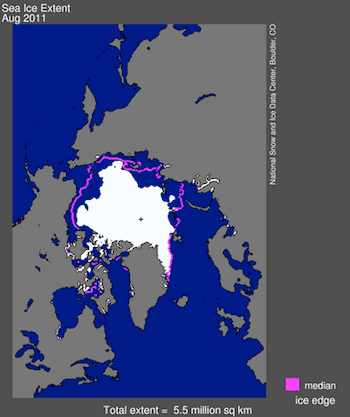
我進入美國國家冰雪資料中心National Snow and Ice Data Center)網站看到最新的資料說,如果光以海冰覆蓋面積來比較,2011年8月北極海冰面積是552萬平方公里,只比2007年8月史上最小面積多了16萬平方公里,或是比1979年到2000年之平均面積少了28%,即215萬平方公里。(Average ice extent for August 2011 was 5.52 million square kilometers (2.13 million square miles). This is 160,000 square kilometers (61,800 square miles) above the previous record low for the month, set in August 2007, and 2.15 million square kilometers (830,000 square miles), or 28% below the average for 1979 to 2000.)
2011年9月6日,美國國家冰雪資料中心網站新聞標題「北極海冰面積接近史上低點(Arctic sea ice near record lows)」,內文說:2011年8月31日,北極海冰面積463萬平方公里,只比2007年同一天的史上最小面積多10萬平方公里。而到了9月5日,海冰面積已經小於2010年9月史上第三低及2008年9月史上第二低的紀錄。如果海冰在9月6日後停止縮減,今年九月的北極海冰面積將是衛星觀測紀錄史上第二低點。(On August 31, 2011 Arctic sea ice extent was 4.63 million square kilometers (1.79 million square miles). This is 100,000 square kilometers (38,600 square miles) higher than the previous record low for the same day of the year, set in 2007. As of September 5, ice extent had fallen below the minimum ice extents in September 2010 and 2008 (previously the third- and second-lowest minima in the satellite record). If ice stopped declining in extent today it would be the second-lowest minimum extent in the satellite record.)
底下是該網站於9/6公布的三則統計圖,可以看出如果溫室效應持續,北極夏天終將無冰的趨勢:
Credit:NSIDC
2011年8月北極海(北冰洋)海冰覆蓋面積(白色區塊)是552萬平方公里,洋紅色線條是1979年到2000年每年8月海冰覆蓋面積的中間數範圍,白色區塊內有一個黑色十字點,那是地理北極。
(Arctic sea ice extent for August 2011 was 5.52 million square kilometers (2.13 million square miles). The magenta line shows the 1979 to 2000 median extent for that month. The black cross indicates the geographic North Pole)
Credit:NSIDC
2011夏天北極海冰覆蓋面積與歷年比較曲線圖,淺藍色實線是2011年6月到9月初的海冰範圍變化曲線,可以看到在九月初幾近與最低紀錄的2007年曲線重疊。最上面灰色實線是1979年到2000年平均夏天海冰範圍變化曲線。量測距離北極海平面1000公尺高度之氣溫,比1981年到2010年的平均氣溫高了攝氏1到4度。
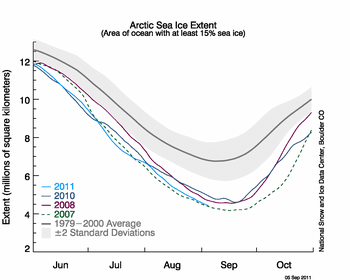
(Air temperatures were 1 to 4 degrees Celsius (2 to 7 degrees Fahrenheit) higher than average (relative to the 1981 to 2010 climatology) over the Arctic Ocean (measured approximately 1000 meters above the surface)).

Credit:NSIDC
1979-2011北極8月冰域縮減趨勢圖(每十年斜率-9.3%)
(Average Arctic sea ice extent for August 2011 was the second-lowest for August in the satellite data record. Including 2011 the linear trend for August now stands at –9.3% per decade.)
以目前這樣的縮減速率下去,如果溫室效應持續影響,真有可能在半個世紀內會出現北極夏天無冰的狀況,現在出生的小朋友,將有可能在其人生某個階段面對氣候巨變的災難。
隨身帶手帕、不喝瓶裝水、電腦要關機、電燈隨手關、冷氣不常開、減廢零丟棄、停車就熄火、蔬食少吃肉、自備購物袋、出門少開車等生活環保小動作都是可輕鬆做到的,端視您是否在意北極有冰無冰與我們何干?
台灣現在無雨則旱、遇雨則淹,這已經不是增建水庫、「整治」河川、加高堤防可以應付的,那是整個環境的惡化,氣候變遷的效應,是人類社會工業化後追求奢華、不顧天理的結果。我們這一代已經看到些微徵兆,也已嘗到一點苦果,若還不知警惕,保守生活行為,更嚴厲的災禍有可能在我們這一代就會面臨,再慢也是子女輩就會碰上。
現在是人類與自然萬物是否可以繼續在地球上生存千萬年的關鍵時刻,儘量發揮影響力給周遭親朋,不要漠視溫室氣體排放的效應,趕快從生活中節能減碳做起,或是就從中秋節(今年是9/12)不烤肉開始吧!
延伸閱讀:
地球暖化新證據—2009夏季北極冰域監測統計相關圖片 20091012
2009夏季北極冰層覆蓋範圍史上第三低 20090921
2008年夏天北極冰域縮到史上第二小範圍 20081008
北極融冰最新證據 20080901
冰河消退影片 20080407
北極冰層範圍急速減縮 20071102
轉載自 賴鵬智的野FUN特區