
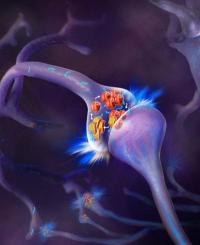
 我們腦中的記憶是由神經元間稱為「突觸(synapses)」的連結所維持。但這些突觸如何維持強健並使記憶維持鮮活達數十年呢?(美國)Stowers Institute for Medical Research 的神經科學家從一項果蠅研究中發現了一條重大線索:一種堅硬、自我複製的突觸蛋白團簇(clusters),或寡聚體(oligomers)是形成長期記憶的必要成份。
這項發現支持一種關於記憶的驚人新理論,對腦中其他與寡聚體相關之功能和疾病(包括阿茲海默症與 prion 疾病)的解釋,也有深遠的影響。
“位於突觸、自給自足的寡聚體族群也許是長期突觸轉變的關鍵,並構成記憶;事實上,我們的發現暗示,寡聚體在腦中扮演比先前所以為還要更廣泛的角色,” Kausik Si, Ph.D. 表示,Stowers Institute 的副研究員、這項新研究的資深作者,該研究已發表在 2012 年的 Cell 期刊線上版。
Si 在該領域的研究始於近十年前他在哥倫比亞大學諾貝爾桂冠,神經科學家 Eric Kandel 實驗室的博士研究期間。他發現 Aplysia californica 這種海蛞蝓(sea slug,因為海蛞蝓擁有大型、容易研究的神經元,所以一直受到進行記憶實驗的神經科學家喜愛)中,有種維持突觸的蛋白質稱為 CPEB(Cytoplasmic Polyadenylation Element Binding protein,細胞質多聚腺苷酸化元素結合蛋白)具有意料之外的特性。
一種有此結構的蛋白質是自補的(self-complementary)而且 — 非常像中空的蛋盒(egg cartons)– 能輕易地與自身的其他副本堆疊。CPEB 因而在神經元中有一部分是以寡聚體的形態存在,當神經元的突觸強化,其數量增加。這些寡聚體對於一般溶劑具有堅強的抗性,而且在神經元內也比單一拷貝的 CPEB 「單體(monomers)」更加穩定許多。充當樣板,從附近的自由單體形成的新寡聚體,它們似乎也藉此「主動維持(actively sustain)」其族群。
CPEB 般的蛋白存在於所有動物體內,而且在腦細胞中,它們扮演維持其他突觸強化蛋白製造的關鍵角色。Si 等人在過去幾年所進行的研究暗示,CPEB 的寡聚體化傾向並非只是偶然,事實上對於其穩固長期記憶的能力而言是必要的。”我們到目前為止仍缺乏的是證明這種確定性的實驗,” Si 表示。
在這項新研究中,Si 等人檢驗 Drosophila 屬果蠅的一種 CPEB 蛋白稱為 Orb2。如同其在 Aplysia 屬的相似物,它在神經元內形成寡聚體。”我們發現,當這些突觸受刺激時,神經元中的 Orb2 寡聚體變得更大量,而那增加寡聚體在突觸附近的出現,” Si 實驗室的博士後研究者,也是第一作者的 Amitabha Majumdar, Ph.D. 表示。
關鍵在於證明,Orb2 寡聚體化的自發擾亂會損及 Orb2 使記憶穩定化的功能。Majumdar 產生一種 Orb2 變種,其缺乏一般寡聚體化的能力,卻仍可在神經元中維持近乎正常的濃度。帶有這種突變的果蠅失去其形成長期記憶的能力。”在記憶形成刺激的第一個 24 小時後,記憶就在那裡,不過 48 小時候,它消失了,但具有正常 Orb2 的果蠅,卻可維持記憶,” Majumdar 說。
Si 與其團隊現在繼續進行實驗,要測定 Orb2 寡聚體需要多久的時間才能使記憶維持鮮明。”我們懷疑它們需要持續存在,因為它們是以一種 Orb2 單體辦不到的方式自給自足,” Si 說。
該團隊的研究也為其他領域的神經科學家提供某些有趣的可能性。這項研究揭露在 Drosophila 神經系統中,Orb2 蛋白有二種形態,高度寡聚體化傾向的形態(Orb2A)很罕見,而非常少寡聚體化傾向的形態(Orb2B)則較常見。”這種罕見形態似乎是調控的那一種,且其作用如同一種初始寡聚體化的種子,能抑制(pulls in)較豐富形態的複製,” Si 表示。”也許結果是有用寡聚體的基本模式。”
這些發現或許也幫助科學家了解致病寡聚體。阿茲海默症、帕金森氏症、亨丁頓舞蹈症以及 prion 疾病,如庫賈氏病(CJD),全都涉及各種蛋白質顯然有毒的寡聚體在腦中的擴散。一種像這樣、強烈涉及阿茲海默症的蛋白,是 amyloid beta;如同 Orb2,它有二種形態,高度寡聚體化 myloid-beta-42 以及相對遲鈍的 amyloid-beta-40。 Si 的研究暗示「寡聚體相關疾病在腦中相對常見」的可能性,因為腦部演化成相對較適合 CPEB 蛋白與其他起作用的寡聚體,也因此使異常(rogue)寡聚體受到控制的機制也比較少。
資料來源:Making memories last: Prion-like protein plays key role in storing long-term memories[January 27, 2012]